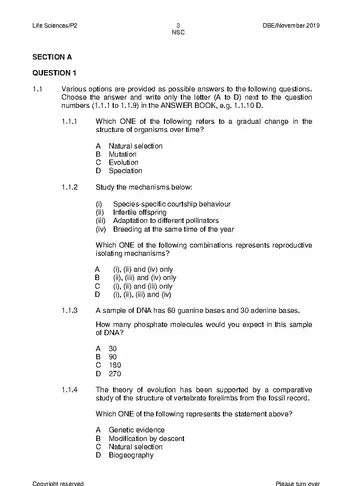
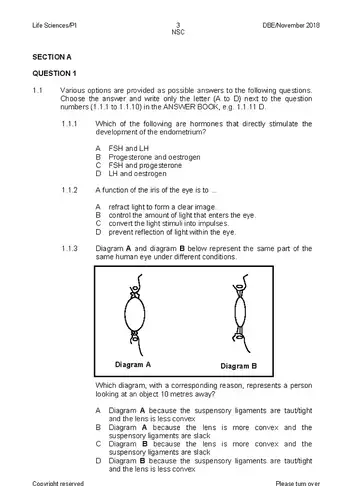
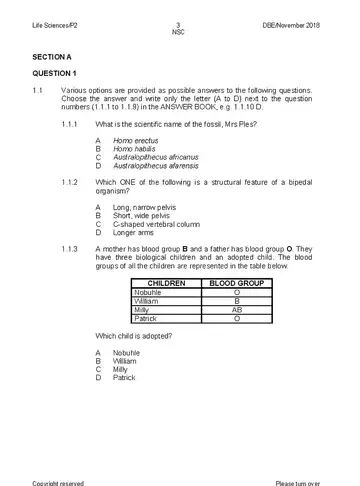
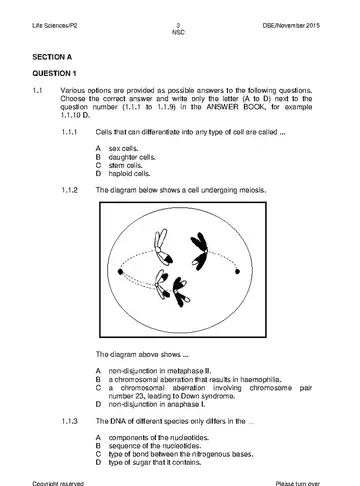
This page has every Life Sciences Grade 12 Term 4 paper we have, from 2011 to 2025: 28 question papers and 27 memos in 98 PDFs. The papers were set by the national DBE. Files are in English and Afrikaans. The newest year is first. Each paper shows the first page of questions, its marks and time, and what the questions cover.
Life Sciences Grade 12 Term 4 papers by year
Life Sciences Grade 12 Term 4 2025 question papers and memos
November 2025 Paper 1 (National DBE)
Life Sciences (Biology) Grade 12 November 2025 Paper 1 (National DBE) question paper
150 marks · 2 h 30 min · 16 pages · 3 questions
What is in this paper (3 questions)
Q1
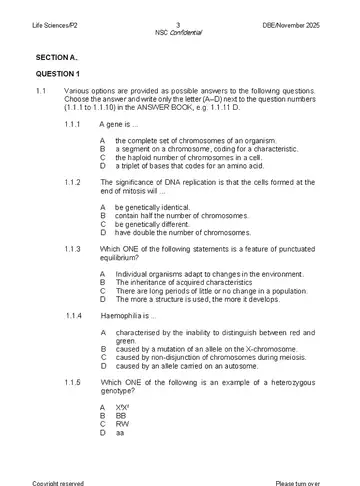
Human endocrine system and homeostasis 1.1 Various options are provided as possible answers to the following questions.
Q2
Human reproduction 2.1 In bird eggs, the yolk is the main source of energy for the developing embryo. 50 marks
Q3
3.1 The diagrams below represent the structure of a normal eye and that of an eye 50 marks
Instructions to candidates Answer ALL the questions. Write ALL the answers in the ANSWER BOOK. Start the answers to EACH question at the top of a NEW page. Number the answers correctly according to the numbering system used in this question paper. Present your answers according to the instructions of each question. Do ALL drawings in pencil and label them in blue or black ink. Draw diagrams, tables or flow charts only when asked to do so. The diagrams in this question paper are NOT necessarily drawn to scale. Do NOT use graph paper. You must use a non-programmable calculator, protractor and a compass, where necessary. Write neatly and legibly. Life Sciences/P1 3
November 2025 Paper 2 (National DBE)
Life Sciences (Biology) Grade 12 November 2025 Paper 2 (National DBE) question paper
150 marks · 2 h 30 min · 17 pages · 3 questions
What is in this paper (3 questions)
Q1
Meiosis 1.1 Various options are provided as possible answers to the following qstueions.
Q2
Meiosis 2.1 The diagram below represents the sex chromosomes in a female. 50 marks
Q3
3.1 Theories of human evolution are based on the similarities between h umans and 50 marks
Instructions to candidates Answer ALL the questions. Write ALL the answers in the ANSWER BOOK. Start the answers to EACH question at the top of a NEW page. Number the answers correctly according to the numbering system used in this question paper. Present your answers according to the instructions of each question. Do ALL drawings in pencil and label them in blue or black ink. Draw diagrams, tables or flow charts only when asked to do so. The diagrams in this question paper are NOT necessarily drawn to scale. Do NOT use graph paper. You must use a noprn-ogrammable calculator, protractor and a compass, where necessary. Write neatly and legibly. Life Sciences/P2 3
Life Sciences Grade 12 Term 4 2024 question papers and memos
November 2024 Paper 1 (National DBE)
Life Sciences (Biology) Grade 12 November 2024 Paper 1 (National DBE) question paper
150 marks · 2 h 30 min · 18 pages · 3 questions
What is in this paper (3 questions)
Q1
Responding to the environment (humans) 1.1 Various options are provided as possible answers to the following questions.
Q2
Responding to the environment (humans) 2.1 The diagram below represents a part of the female reproductive system. 50 marks
Q3
3.1 The passage below describes the breeding habits of vultures. 50 marks
Instructions to candidates Answer ALL the questions. Write ALL the answers in the ANSWER BOOK. Start the answers to EACH question at the top of a NEW page. Number the answers correctly according to the numbering system used in this question paper. Present your answers according to the instructions of each question. Do ALL drawings in pencil and label them in blue or black ink. Draw diagrams, tables or flow charts only when asked to do so. The diagrams in this question paper are NOT necessarily drawn to scale. Do NOT use graph paper. You must use a non-programmable calculator, protractor and a compass, where necessary. Write neatly and legibly. Life Sciences/P1 3
November 2024 Paper 2 (National DBE)
Life Sciences (Biology) Grade 12 November 2024 Paper 2 (National DBE) question paper
150 marks · 2 h 30 min · 14 pages · 3 questions
What is in this paper (3 questions)
Q1
Meiosis 1.1 Various options are provided as possible answers to the following questions.
Q2
Genetics and inheritance 2.1 The diagram below represents a certain stage of protein synthesis. 50 marks
Q3
3.1 Read the passage below. 50 marks
Instructions to candidates Answer ALL the questions. Write ALL the answers in the ANSWER BOOK. Start the answers to EACH question at the top of a NEW page. Number the answers correctly according to the numbering system used in this question paper. Present your answers according to the instructions of each question. Do ALL drawings in pencil and label them in blue or black ink. Draw diagrams, tables or flow charts only when asked to do so. The diagrams in this question paper are NOT necessarily drawn to scale. Do NOT use graph paper. You must use a non-programmable calculator, protractor and a compass, where necessary. Write neatly and legibly. Life Sciences/P2 3
Life Sciences Grade 12 Term 4 2023 question papers and memos
November 2023 Paper 1 (National DBE)
Life Sciences (Biology) Grade 12 November 2023 Paper 1 (National DBE) question paper
150 marks · 2 h 30 min · 19 pages · 3 questions
What is in this paper (3 questions)
Q1
Responding to the environment (humans) 1.1 Various options are provided as possible answers to the following questions.
Q2
Responding to the environment (humans) 2.1 In some frog species, during mating, the male climbs onto the back of the 50 marks
Q3
3.1 Read the extract below. 50 marks
Instructions to candidates Answer ALL the questions. Write ALL the answers in the ANSWER BOOK. Start the answers to EACH question at the top of a NEW page. Number the answers correctly according to the numbering system used in this question paper. Present your answers according to the instructions of each question. Do ALL drawings in pencil and label them in blue or black ink. Draw diagrams, tables or flow charts only when asked to do so. The diagrams in this question paper are NOT necessarily drawn to scale. Do NOT use graph paper. You must use a non-programmable calculator, protractor and a compass, where necessary. Write neatly and legibly. Life Sciences/P1 3
November 2023 Paper 2 (National DBE)
Life Sciences (Biology) Grade 12 November 2023 Paper 2 (National DBE) question paper
150 marks · 2 h 30 min · 15 pages · 3 questions
What is in this paper (3 questions)
Q1
Meiosis 1.1 Various options are provided as possible answers to the following questions.
Q2
Meiosis 2.1 The diagrams below represent two stages of meiotic cell division. 50 marks
Q3
3.1 The graph below shows the results of artificial selection for protein content in 50 marks
Instructions to candidates Answer ALL the questions. Write ALL the answers in the ANSWER BOOK. Start the answers to EACH question at the top of a NEW page. Number the answers correctly according to the numbering system used in this question paper. Present your answers according to the instructions of each question. Do ALL drawings in pencil and label them in blue or black ink. Draw diagrams, tables or flow charts only when asked to do so. The diagrams in this question paper are NOT necessarily drawn to scale. Do NOT use graph paper. You must use a non-programmable calculator, protractor and a compass, where necessary. Write neatly and legibly. Life Sciences/P2 3
Life Sciences Grade 12 Term 4 2022 question papers and memos
November 2022 Paper 1 (National DBE)
Life Sciences (Biology) Grade 12 November 2022 Paper 1 (National DBE) question paper
150 marks · 2 h 30 min · 17 pages · 3 questions
What is in this paper (3 questions)
Q1
Human endocrine system and homeostasis 1.1 Various options are provided as possible answers to the following questions.
Q2
Human endocrine system and homeostasis 2.1 The diagram below represents the human male reproductive system. 50 marks
Q3
3.1 The diagram below shows a part of the human brain. 50 marks
Instructions to candidates Answer ALL the questions. Write ALL the answers in the ANSWER BOOK. Start the answers to EACH question at the top of a NEW page. Number the answers correctly according to the numbering system used in this question paper. Present your answers according to the instructions of each question. Do ALL drawings in pencil and label them in blue or black ink. Draw diagrams, tables or flow charts only when asked to do so. The diagrams in this question paper are NOT necessarily drawn to scale. Do NOT use graph paper. You must use a non-programmable calculator, protractor and a compass, where necessary. Write neatly and legibly. Life Sciences/P1 3
November 2022 Paper 2 (National DBE)
Life Sciences (Biology) Grade 12 November 2022 Paper 2 (National DBE) question paper
150 marks · 2 h 30 min · 15 pages · 3 questions
What is in this paper (3 questions)
Q1
Meiosis 1.1 Various options are provided as possible answers to the following questions.
Q2
Meiosis 2.1 The diagram below represents transcription during protein synthesis.
Q3
3.1 Read the extract below. 50 marks
Instructions to candidates Answer ALL the questions. Write ALL the answers in the ANSWER BOOK. Start the answers to EACH question at the top of a NEW page. Number the answers correctly according to the numbering system used in this question paper. Present your answers according to the instructions of each question. Do ALL drawings in pencil and label them in blue or black ink. Draw diagrams, tables or flow charts only when asked to do so. The diagrams in this question paper are NOT necessarily drawn to scale. Do NOT use graph paper. You must use a non-programmable calculator, protractor and a compass, where necessary. Write neatly and legibly. Life Sciences/P2 3
Life Sciences Grade 12 Term 4 2021 question papers and memos
November 2021 Paper 1 (National DBE)
Life Sciences (Biology) Grade 12 November 2021 Paper 1 (National DBE) question paper
150 marks · 2 h 30 min · 16 pages · 3 questions
What is in this paper (3 questions)
Q1
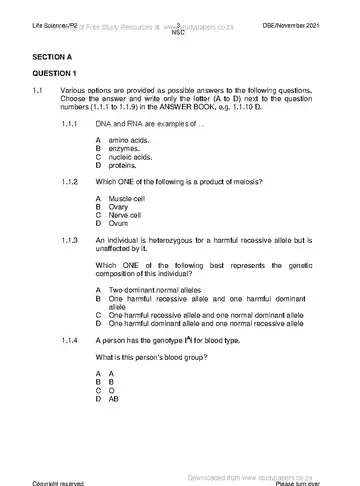
Responding to the environment (humans) 1.1 Various options are provided as possible answers to the following questions.
Q2
Responding to the environment (humans) 2.1 The diagram below represents a type of neuron found in the human body. 50 marks
Q3
3.1 The diagrams below show the human brain and human kidney. 50 marks
Instructions to candidates Answer ALL the questions. Write ALL the answers in the ANSWER BOOK. Start the answers to EACH question at the top of a NEW page. Number the answers correctly according to the numbering system used in this question paper. Present your answers according to the instructions of each question. Do ALL drawings in pencil and label them in blue or black ink. Draw diagrams, tables or flow charts only when asked to do so. The diagrams in this question paper are NOT necessarily drawn to scale. Do NOT use graph paper. You must use a non-programmable calculator, protractor and a compass, where necessary. Write neatly and legibly. Life Sciences/P1 3
November 2021 Paper 2 (National DBE)
Life Sciences (Biology) Grade 12 November 2021 Paper 2 (National DBE) question paper
150 marks · 2 h 30 min · 17 pages · 3 questions
What is in this paper (3 questions)
Q1
Genetics and inheritance 1.1 Various options are provided as possible answers to the following questions.
Q2
Meiosis 2.1 The diagram below represents two processes that occur during protein 50 marks
Q3
3.1 Some horses have straight hair and others have curly hair. A scientist wanted 50 marks
Instructions to candidates Answer ALL the questions. Write ALL the answers in the ANSWER BOOK. Start the answers to EACH question at the top of a NEW page. Number the answers correctly according to the numbering system used in this question paper. Present your answers according to the instructions of each question. Do ALL drawings in pencil and label them in blue or black ink. Draw diagrams, tables or flow charts only when asked to do so. The diagrams in this question paper are NOT necessarily drawn to scale. Do NOT use graph paper. You must use a non-programmable calculator, protractor and a compass, where necessary. Write neatly and legibly. Life Sciences/P2 3
Life Sciences Grade 12 Term 4 2020 question papers and memos
November 2020 Paper 1 (National DBE)
Life Sciences (Biology) Grade 12 November 2020 Paper 1 (National DBE) question paper
150 marks · 2 h 30 min · 16 pages · 4 questions
What is in this paper (4 questions)
Q1
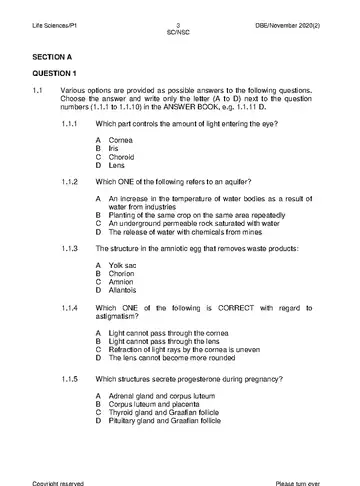
Responding to the environment (humans) 1.1 Various options are provided as possible answers to the following questions.
Q2
Human endocrine system and homeostasis 2.1 The diagrams below show different parts of the brain and the ear. 40 marks
Q3
Human reproduction 3.1 The diagrams below represent two phases of meiosis. 40 marks
Q4
Describe how the human body maintains the temperature and carbon dioxide 20 marks
Instructions to candidates Answer ALL the questions. Write ALL the answers in the ANSWER BOOK. Start the answers to EACH question at the top of a NEW page. Number the answers correctly according to the numbering system used in this question paper. Present your answers according to the instructions of each question. Do ALL drawings in pencil and label them in blue or black ink. Draw diagrams, tables or flow charts only when asked to do so. The diagrams in this question paper are NOT necessarily drawn to scale. Do NOT use graph paper. You must use a non-programmable calculator, protractor and a compass, where necessary. Write neatly and legibly. Life Sciences/P1 3
November 2020 Paper 2 (National DBE)
Life Sciences (Biology) Grade 12 November 2020 Paper 2 (National DBE) question paper
150 marks · 2 h 30 min · 17 pages · 4 questions
What is in this paper (4 questions)
Q1
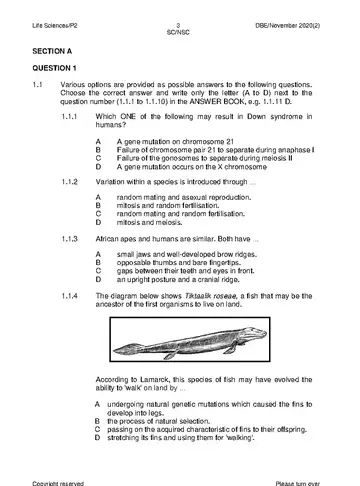
Meiosis 1.1 Various options are provided as possible answers to the following questions.
Q2
Genetics and inheritance 2.1 Detectives were investigating a crime scene and found blood on a broken 40 marks
Q3
Evolution 3.1 Describe the process of natural selection. (7) 40 marks
Q4
Describe the location and structure of DNA, the process of DNA replication and the
Instructions to candidates Answer ALL the questions. Write ALL the answers in the ANSWER BOOK. Start the answers to EACH question at the top of a NEW page. Number the answers correctly according to the numbering system used in this question paper. Present your answers according to the instructions of each question. Do ALL drawings in pencil and label them in blue or black ink. Draw diagrams, tables or flow charts only when asked to do so. The diagrams in this question paper are NOT necessarily drawn to scale. Do NOT use graph paper. You must use a non-programmable calculator, protractor and a compass, where necessary. Write neatly and legibly. Life Sciences/P2 3
Life Sciences Grade 12 Term 4 2019 question papers and memos
November 2019 Paper 1 (National DBE)
Life Sciences (Biology) Grade 12 November 2019 Paper 1 (National DBE) question paper
150 marks · 2 h 30 min · 16 pages · 4 questions
What is in this paper (4 questions)
Q1
Human reproduction 1.1 Various options are provided as possible answers to the following questions.
Q2
Reproduction in vertebrates 2.1 The diagrams below represent different phases of meiosis in an organism. 40 marks
Q3
Human endocrine system and homeostasis 3.1 The diagrams below show the re-absorption of salt and water through the 40 marks
Q4
Both plants and humans respond to gravity.
Instructions to candidates Answer ALL the questions. Write ALL the answers in the ANSWER BOOK. Start the answers to EACH question at the top of a NEW page. Number the answers correctly according to the numbering system used in this question paper. Present your answers according to the instructions of each question. Do ALL drawings in pencil and label them in blue or black ink. Draw diagrams, tables or flow charts only when asked to do so. The diagrams in this question paper are NOT necessarily drawn to scale. Do NOT use graph paper. You must use a non-programmable calculator, protractor and a compass, where necessary. Write neatly and legibly.
November 2019 Paper 2 (National DBE)
Life Sciences (Biology) Grade 12 November 2019 Paper 2 (National DBE) question paper
150 marks · 2 h 30 min · 14 pages · 4 questions
What is in this paper (4 questions)
Q1
DNA and protein synthesis 1.1 Various options are provided as possible answers to the following questions.
Q2
DNA and protein synthesis 2.1 The diagram below shows part of a process involved in the production of a 40 marks
Q3
Evolution 3.1 The diagrams below show the skulls of two species of primates. 40 marks
Q4
Sometimes the paternity of a son or a daughter is disputed.
Instructions to candidates Answer ALL the questions. Write ALL the answers in the ANSWER BOOK. Start the answers to EACH question at the top of a NEW page. Number the answers correctly according to the numbering system used in this question paper. Present your answers according to the instructions of each question. Do ALL drawings in pencil and label them in blue or black ink. Draw diagrams, tables or flow charts only when asked to do so. The diagrams in this question paper are NOT necessarily drawn to scale. Do NOT use graph paper. You must use a non-programmable calculator, protractor and a compass, where necessary. Write neatly and legibly.
Life Sciences Grade 12 Term 4 2018 question papers and memos
November 2018 Paper 1 (National DBE)
Life Sciences (Biology) Grade 12 November 2018 Paper 1 (National DBE) question paper
150 marks · 2 h 30 min · 19 pages · 4 questions
What is in this paper (4 questions)
Q1
Meiosis 1.1 Various options are provided as possible answers to the following questions.
Q2
Meiosis 2.1 The diagrams below represent various phases of meiosis. 40 marks
Q3
Human endocrine system and homeostasis 3.1 The diagrams below representthe growth responses of two different plant
Q4
Describe how human activities have caused rapid global warming over the last century,
Instructions to candidates Answer ALL the questions. Write ALL the answers in the ANSWER BOOK. Start the answers to EACH question at the top of a NEW page. Number the answers correctly according to the numbering system used in this question paper. Present your answers according to the instructions of each question. Do ALL drawings in pencil and label them in blue or black ink. Draw diagrams, tables or flow charts only when asked to do so. The diagrams in this question paper are NOT necessarily drawn to scale. Do NOT use graph paper. You must use a noprogn-rammable calculator, protractor and a compass, where necessary. Write neatly and legibly. Life Sciences/P1 3
November 2018 Paper 2 (National DBE)
Life Sciences (Biology) Grade 12 November 2018 Paper 2 (National DBE) question paper
150 marks · 2 h 30 min · 16 pages · 4 questions
What is in this paper (4 questions)
Q1
Genetics and inheritance 1.1 Various options are provided as possible answers to the following questions .
Q2
Meiosis 2.1 The diagrams below represent the distribution of chromosompae ir 21 as it 40 marks
Q3
Evolution 3.1 The diagrams below show the upper jaws of some fossils. These diagrams 40 marks
Q4
Describe the structure of RNAin a cell and the involvement of the different types of
Instructions to candidates Answer ALL the questions. Write ALL the answers in the ANSWER BOOK. Start the answers to EACH question at the top of a NEW page. Number the answers correctly according to the numbering system used in this question paper. Present your answers according to the instructions of each question. Do ALL drawings in pencil and label them in blue or black ink. Draw diagrams, tables or flow charts only when asked to do so. The diagrams in this question paper are NOT necessarily drawn to scale. Do NOT use graph paper. You must use a noprogn-rammable calculator, protractor and a compass, where necessary. Write neatly and legibly. Life Sciences/P2 3
Life Sciences Grade 12 Term 4 2017 question papers and memos
November 2017 Paper 1 (National DBE)
Life Sciences (Biology) Grade 12 November 2017 Paper 1 (National DBE) question paper
150 marks · 2 h 30 min · 15 pages · 4 questions
What is in this paper (4 questions)
Q1
Responding to the environment (humans) 1.1 Various options are provided as possible answers to the following questions .
Q2
Meiosis 2.1 The graph below indicates the amount of water in the dams in each province 40 marks
Q3
Human endocrine system and homeostasis 3.1 The diagram below represents a germinating seed. Assume that the radicle 40 marks
Q4
Sperm is produced, transported and then combined with secretions from the accessory
Instructions to candidates Answer ALL the questions. Write ALL the answers in the ANSWER BOOK. Start the answers to EACH question at the top of a NEW page. Number the answers correctly according to the numbering system used in this question paper. Present your answers according to the instructions of each question. Do ALL drawings in pencil and label them in blue or black ink. Draw diagrams, tables or flow charts only when asked to do so. The diagrams in this question paper are NOT necessarily drawn to scale. Do NOT use graph paper. You must use a noprogn-rammable calculator, protractor and a compass, where necessary. Write neatly and legibly.
November 2017 Paper 2 (National DBE)
Life Sciences (Biology) Grade 12 November 2017 Paper 2 (National DBE) question paper
150 marks · 2 h 30 min · 15 pages · 4 questions
What is in this paper (4 questions)
Q1
DNA and protein synthesis 50 marks
Q2
Meiosis 40 marks
Q3
Responding to the environment (humans) 40 marks
Q4
Question 4
Instructions to candidates Beantwoord AL die vrae. Skryf AL die antwoorde in die ANTWOORDEBOEK. Begin die antwoorde op ELKE vraag boaan 'n NUWE bladsy. Nommer die antwoorde korrek volgens die nommeringstelsel wat in hierdie vraestel gebruik is. Bied jou antwoorde volgens die instruksies by elke vraag aan. Maak ALLE sketse met potlood en die byskrifte met blou of swart ink. Teken diagramme, vloeidiagramme of tabelle slegs wanneer dit gevra word. Die diagramme in hierdie vraestel is NIE noodwendig volgens skaal geteken NIE. MOENIE grafiekpapier gebruik NIE. Jy moet 'n nieprogrammeerbare sakrekenaar, gradeboog en passer gebruik, waar nodig. Skryf netjies en leesbaar.
Life Sciences Grade 12 Term 4 2016 question papers and memos
November 2016 Paper 1 (National DBE)
Life Sciences (Biology) Grade 12 November 2016 Paper 1 (National DBE) question paper
150 marks · 2 h 30 min · 19 pages · 4 questions
What is in this paper (4 questions)
Q1
Responding to the environment (humans) 1.1 Various options are provided as possible answers to the following questions .
Q2
2.1 The diagram below represents the human male reproductive system. 40 marks
Q3
Responding to the environment (humans) 3.1 The diagram below represents a neuron in a human. 40 marks
Q4
While walking in the bush Paul hears a sound which he thi nkthe rs isoar o fa lion.
Instructions to candidates Answer ALL the questions. Write ALL the answers in the ANSWER BOOK. Start the answers to EACH question at the top of a NEW page. Number the answers correctly according to the numbering system used in this question paper. Present your answers according to the instructions of each question. Make ALL drawings in pencil and label them in blue or black ink. Draw diagrams, tables or flow charts only when asked to do so. The diagrams in this question paper are NOT necessarily drawn to scale. Do NOT use graph paper. You must use a n-pronogrammable calculator, protractor and a compass, where necessary. Write neatly and legibly.
November 2016 Paper 2 (National DBE)
Life Sciences (Biology) Grade 12 November 2016 Paper 2 (National DBE) question paper
150 marks · 2 h 30 min · 18 pages · 4 questions
What is in this paper (4 questions)
Q1
DNA and protein synthesis 1.1 Various options are provided as possible answers to the following questions .
Q2
Genetics and inheritance 2.1 The leaf colour in a plant is controlled by two alleles, green (G) and yellow (g). 40 marks
Q3
Genetics and inheritance 3.1 Read the passage below. 40 marks
Q4
Fossils of the bipedal primates Ardipithecus, Australopithecus and early Homo species
Instructions to candidates Answer ALL the questions. Write ALL the answers in the ANSWER BOOK. Start the answers to EACH question at the top of a NEW page. Number the answers correctly according to the numbering system used in this question paper. Present your answers according to the instructions of each question. Make ALL drawings in pencil and label them in blue or black ink. Draw diagrams, tables or flow charts only when asked to do so. The diagrams in this question paper are NOT necessarily drawn to scale. Do NOT use graph paper. You must use a n-pronogrammable calculator, protractor and a compass, where necessary. Write neatly and legibly.
Life Sciences Grade 12 Term 4 2015 question papers and memos
November 2015 Paper 1 (National DBE)
Life Sciences (Biology) Grade 12 November 2015 Paper 1 (National DBE) question paper
150 marks · 2 h 30 min · 17 pages · 4 questions
What is in this paper (4 questions)
Q1
Responding to the environment (humans) 1.1 Various options are given as possible answers to the following questions.
Q2
Human reproduction 2.1 The diagram below represents a part of the human ear. 40 marks
Q3
3.1 Describe how the human body restores the carbon dioxide concentration in 40 marks
Q4
Explain the structural suitability of the sperm cell for its function and describe its
Instructions to candidates Answer ALL the questions. Write ALL the answers in the ANSWER BOOK. Start the answers to EACH question at the top of a NEW page. Number the answers correctly according to the numbering system used in this question paper. Present your answers according to the instructions of each question. ALL drawings must be done in pencil and labelled in blue or black ink. Draw diagrams, flow charts or tables only when asked to do so. The diagrams in this question paper are NOT necessarily drawn to scale. Do NOT use graph paper. You must use a non-programmable calculator, protractor and a compass, where necessary. Write neatly and legibly.
November 2015 Paper 2 (National DBE)
Life Sciences (Biology) Grade 12 November 2015 Paper 2 (National DBE) question paper
150 marks · 2 h 30 min · 15 pages · 4 questions
What is in this paper (4 questions)
Q1
Evolution 1.1 Various options are provided as possible answers to the following questions.
Q2
Meiosis 2.1 The diagrams below represent the process of speciation in tortoises. 40 marks
Q3
DNA and protein synthesis 3.1 Read the extract below. 40 marks
Q4
Describe the process of protein synthesis and the way in which this process would be
Instructions to candidates Answer ALL the questions. Write ALL the answers in the ANSWER BOOK. Start the answers to EACH question at the top of a NEW page. Number the answers correctly according to the numbering system used in this question paper. Present your answers according to the instructions of each question. ALL drawings must be done in pencil and labelled in blue or black ink. Draw diagrams, tables or flow charts only when asked to do so. The diagrams in this question paper are NOT necessarily drawn to scale. Do NOT use graph paper. You must use a non-programmable calculator, protractor and a compass, where necessary. Write neatly and legibly.
Life Sciences Grade 12 Term 4 2013 question papers and memos
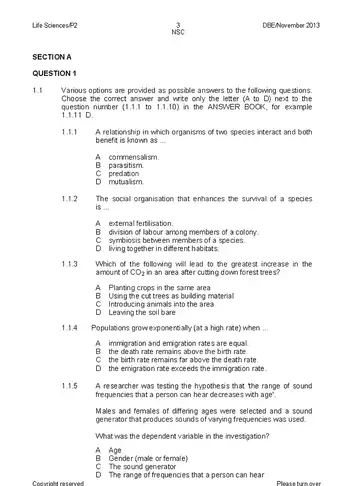
November 2013 Paper 1 (National DBE)
Life Sciences (Biology) Grade 12 November 2013 Paper 1 (National DBE) question paper
150 marks · 2 h 30 min · 15 pages · 4 questions
The memo for this paper is not available yet.
What is in this paper (4 questions)
Q1
Meiosis 1.1 Various options are provided as possible answers to the followingques tions.
Q2
Meiosis 2.1 Study the diagram below, which shows a section of a DNA molecule during 30 marks
Q3
3.1 Read the extract below. 30 marks
Q4
4.1 Although copper is an essential nutrient for the growth of plants, it is toxic and
Instructions to candidates Answer ALL the questions. Write ALL the answers in the ANSWER BOOK. Start the answer to EACH question at the top of a NEW page. Number the answers correctly according to the numbering system used in this question paper. Present your answers according to the instructions of each question. Do ALL drawings in pencil and label them in blue or black ink. Draw diagrams or flow charts only when asked to do so. The diagrams in this question paper are NOT necessarily drawn to scale. Do NOT use graph paper. You must use a non-programmable calculator, protractor and a compass where necessary. Write neatly and legibly.
November 2013 Paper 2 (National DBE)
Life Sciences (Biology) Grade 12 November 2013 Paper 2 (National DBE) question paper
150 marks · 2 h 30 min · 17 pages · 4 questions
What is in this paper (4 questions)
Q1
1.1 Various options are provided as possible answers to the following questions .
Q2
Responding to the environment (humans) 2.1 The diagram below shows a part of the central nervous system. 30 marks
Q3
3.1 The graph below shows the survivorship in two countries (A and B). 30 marks
Q4
4.1 A learner investigated the effects of two plant growth substances, gibberellins
Instructions to candidates Answer ALL the questions. Write ALL the answers in the ANSWER BOOK. Start the answer to EACH question at the top of a NEW page. Number the answers correctly according to the numbering system used in this question paper. Present your answers according to the instructions of each question. Do ALL drawings in pencil and label them in blue or black ink. Draw diagrams or flow charts only when asked to do so. The diagrams in this question paper are NOT necessarily drawn to scale. Do NOT use graph paper. You must use a non-programmable calculator, protractor and a compas s where necessary. Write neatly and legibly.
Life Sciences Grade 12 Term 4 2012 question papers and memos
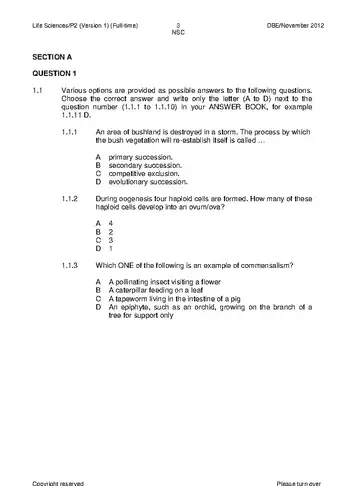
November 2012 Paper 1 (National DBE)
Life Sciences (Biology) Grade 12 November 2012 Paper 1 (National DBE) question paper
150 marks · 2 h 30 min · 16 pages · 4 questions
What is in this paper (4 questions)
Q1
DNA and protein synthesis 1.1 Various options are provided as possible answertso t he following questions.
Q2
Meiosis 2.1 The diagram below shows crossing over in a pai r of homologous 30 marks
Q3
Human impact on the environment 3.1 The pedigree diagram below traces the inheritance of haemophilia in a family. 30 marks
Q4
4.1 Study the information aboutthe discovery of a new species o f
Instructions to candidates Answer ALL the questions. Write ALL the answers in your ANSWER BOOK. Start the answer to EACH question at the top of a NEW page. Number the answers correctly according to the numbering system used in this question paper. Present your answers according to the instructions of each question. ALL drawings should be done in pencil and labelled in blue or black ink. Draw diagrams or flow charts only when asked to do so. The diagrams in this question paper are NOT necessarily all drawn to scale. Do NOT use graph paper. You may use a non-programmable calculator, protractor and compass where necessary. Write neatly and legibly.
November 2012 Paper 2 (National DBE)
Life Sciences (Biology) Grade 12 November 2012 Paper 2 (National DBE) question paper
150 marks · 2 h 30 min · 18 pages · 4 questions
What is in this paper (4 questions)
Q1
Human endocrine system and homeostasis 1.1 Various options are provided as possible answer tso the following questions.
Q2
Responding to the environment (humans) 2.1 Study the diagram representing the structure of the human brain below. 30 marks
Q3
3.1 The table below illustrates the data collected durings an itigation tonve 30 marks
Q4
4.1 Read the passage below and answer the questions that follow.
Instructions to candidates Answer ALL the questions. Write ALL the answers in your ANSWER BOOK. Start the answer to each question at the top of a NEW page. Number the answers correctly according to the numbering system used in this question paper. Present your answers according to the instructions of each question. ALL drawings should be done in pencil and labelled in blue or black ink. Draw diagrams or flow charts only when asked to do so. The diagrams in this question paper are NOT necessarily all drawn to scale. Do NOT use graph paper. You may use a noprn-ogrammable calculator, protractor and a compas s where necessary. Write neatly and legibly.
Life Sciences Grade 12 Term 4 2011 question papers and memos
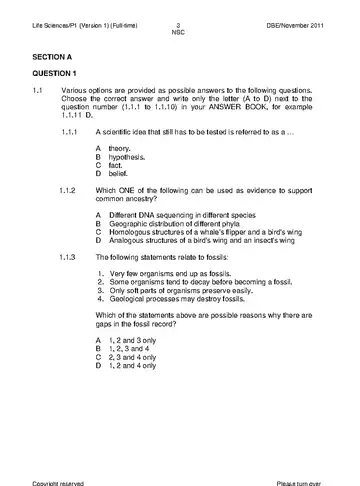
November 2011 Paper 1 (National DBE)
Life Sciences (Biology) Grade 12 November 2011 Paper 1 (National DBE) question paper
150 marks · 2 h 30 min · 13 pages · 4 questions
What is in this paper (4 questions)
Q1
Human reproduction 1.1 Various possible options are provided as answers to the following
Q2
Meiosis 2.1 The relative amounts of DNA were measured in the cells of a plant during 30 marks
Q3
Genetics and inheritance 3.1 In rabbits the dominant allele (B) produces black fur and the recessive allele 30 marks
Q4
4.1 Study the diagram below that shows the cloning of a sheep named Dolly.
Instructions to candidates Answer ALL the questions. Write ALL the answers in your ANSWER BOOK. Start the answers to each question at the top of a NEW page. Number the answers correctly according to the numbering system used in this question paper. Present your answers according to the instructions of each question. ALL drawings should be done in pencil and labelled in blue or black ink. Draw diagrams or flow charts only when asked to do so. The diagrams in this question paper are NOT necessarily drawn to scale. Do NOT use graph paper. You may use a non-programmable calculator, protractor and a compass. Write neatly and legibly.
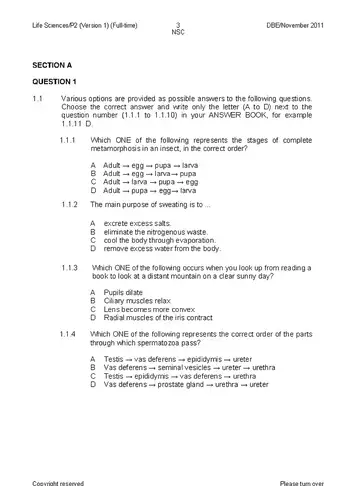
November 2011 Paper 2 (National DBE)
Life Sciences (Biology) Grade 12 November 2011 Paper 2 (National DBE) question paper
150 marks · 2 h 30 min · 19 pages · 4 questions
What is in this paper (4 questions)
Q1
Responding to the environment (humans) 1.1 Various options are provided as possible answers to the following question s.
Q2
Responding to the environment (humans) 2.1 Study the diagram below showing a portion of the human ear and answer the 30 marks
Q3
determine the population size of a type of fish (Tilapia sparrmanii) in a large 30 marks
Q4
4.1 Study the table below showing changes in the human population size of the
Instructions to candidates Answer ALL the questions. Write ALL the answers in your ANSWER BOOK. Start the answers to each question at the top of a NEW page. Number the answers correctly according to the numbering system used in this question paper. Present your answers according to the instructions of each question. ALL drawings should be done in pencil and labelled in blue or black ink. Draw diagrams or flow charts only when asked to do so. The diagrams in this question paper are NOT necessarily all drawn to scale. Do NOT use graph paper. You may use non-programmable calculators, protractors and compasses. Write neatly and legibly.
No papers match. Clear the filters
Questions about these papers
Which years of Life Sciences (Biology) Grade 12 Term 4 papers are on this page? Papers from 2025, 2024, 2023, 2022, 2021, 2020, 2019, 2018, 2017, 2016, 2015, 2013, 2012, 2011. The newest year is at the top.
How many marks is the Life Sciences (Biology) Grade 12 Term 4 paper 1? Paper 1 is usually out of 150 marks and you get 2 h 30 min to write it.
How many marks is the Life Sciences (Biology) Grade 12 Term 4 paper 2? Paper 2 is usually out of 150 marks and you get 2 h 30 min to write it.
Are the memos included? Yes. 27 of the 28 papers on this page have their marking memo next to the question paper.