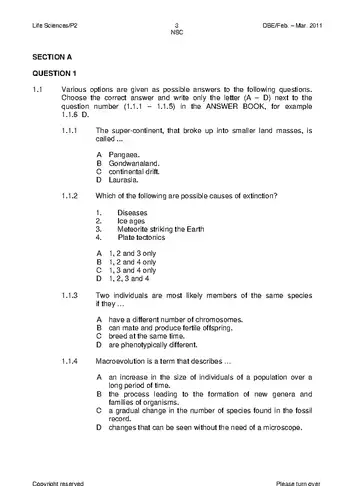
This page has every Life Sciences Grade 12 Term 1 paper we have, from 2011 to 2026: 25 question papers and 21 memos in 67 PDFs. The papers were set by KwaZulu-Natal, North West and the national DBE. Files are in English and Afrikaans. The newest year is first. Each paper shows the first page of questions, its marks and time, and what the questions cover. Below the papers there are 7 files of Term 1 study material.
Life Sciences Grade 12 Term 1 papers by year
Year Exams Papers PDFs
2026 March Test 2 4 2025 March Test 1 1 2024 March Test 1 1 2023 March Test 1 1 2022 March Test 1 1 2021 Feb/March Supplementary 2 2 2020 March Test 1 1 2018 Feb/March Supplementary 2 6 2017 Feb/March Supplementary 2 8 2016 Feb/March Supplementary 2 6 2015 Feb/March Supplementary 2 6 2014 Feb/March Supplementary 2 4 2013 Feb/March Supplementary 2 6 2012 Feb/March Supplementary 2 6 2011 Feb/March Supplementary 2 7
Life Sciences Grade 12 Term 1 2026 question papers and memos
March Test 2026 (KwaZulu-Natal)
Life Sciences (Biology) Grade 12 March Test 2026 (KwaZulu-Natal) question paper
March Test 2026 (North West)
Life Sciences (Biology) Grade 12 March Test 2026 (North West) question paper
The memo for this paper is not available yet.
Life Sciences Grade 12 Term 1 2025 question papers and memos
March Test 2025 (KwaZulu-Natal)
Life Sciences (Biology) Grade 12 March Test 2025 (KwaZulu-Natal) question paper
Life Sciences Grade 12 Term 1 2024 question papers and memos
March Test 2024 (KwaZulu-Natal)
Life Sciences (Biology) Grade 12 March Test 2024 (KwaZulu-Natal) question paper
Life Sciences Grade 12 Term 1 2023 question papers and memos
March Test 2023
Life Sciences (Biology) Grade 12 March Test 2023 question paper
Life Sciences Grade 12 Term 1 2022 question papers and memos
March Test 2022
Life Sciences (Biology) Grade 12 March Test 2022 question paper
Life Sciences Grade 12 Term 1 2021 question papers and memos
Feb/March Supplementary 2021 Paper 1 (National DBE)
Life Sciences (Biology) Grade 12 Feb/March Supplementary 2021 Paper 1 (National DBE) question paper
18 pages
The memo for this paper is not available yet.
Feb/March Supplementary 2021 Paper 2 (National DBE)
Life Sciences (Biology) Grade 12 Feb/March Supplementary 2021 Paper 2 (National DBE) question paper
14 pages
The memo for this paper is not available yet.
Life Sciences Grade 12 Term 1 2020 question papers and memos
March Test 2020 (KwaZulu-Natal)
Life Sciences (Biology) Grade 12 March Test 2020 (KwaZulu-Natal) question paper
60 marks · 1 hour · 9 pages · 4 questions
The memo for this paper is not available yet.
What is in this paper (4 questions)
Q1
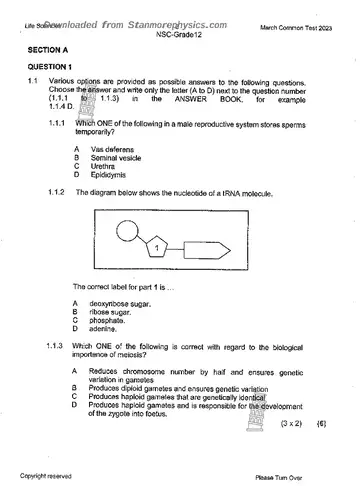
Human reproduction 1.1 Various options are provided as possible answers to the following questions.
Q2
Meiosis 2.1 The diagram below represents a phase of meiosis. 15 marks
Q3
DNA and protein synthesis 3.1 The diagram below shows some codons of mRNA together with their
Q4
Describe the role of ovarian hormones in menstrual cycle and the process of
Instructions to candidates Answer ALL the questions. Write ALL the answers in the ANSWER BOOK. Start the answers to each question at the top of a NEW page. Number the answers correctly according to the numbering system used in this question paper. Present your answers according to the instructions of each question. Do ALL drawings in pencil and label them in blue or black ink. Draw diagrams, tables or flow charts only when asked to do so. The diagrams in this question paper are NOT necessarily drawn to scale. Do NOT use graph paper. You may use a non-programmable calculator, protractor and a compass. Write neatly and legibly. Life Sciences Grade 12 March 2020 Common test 3
Life Sciences Grade 12 Term 1 2018 question papers and memos
Feb/March Supplementary 2018 Paper 1 (National DBE)
Life Sciences (Biology) Grade 12 Feb/March Supplementary 2018 Paper 1 (National DBE) question paper
150 marks · 2 h 30 min · 15 pages · 4 questions
What is in this paper (4 questions)
Q1
Meiosis II 1.1 Various options are given as possible answers to the following questions. 1 marks
Q2
Meiosis 2.1 The diagram below represents the sequence of events that takes place during 40 marks
Q3
Meiosis 3.1 Study the extract and the table below. 40 marks
Q4
An increase in the metabolic rate during strenuous exercise causes a decrease in the
Instructions to candidates Answer ALL the questions. Write ALL the answers in the ANSWER BOOK. Start the answers to EACH question at the top of a NEW page. Number the answers correctly according to the numbering system used in this question paper. Present your answers according to the instructions of each question. Do ALL drawings in pencil and label them in blue or black ink. Draw diagrams, tables or flow charts only when asked to do so. The diagrams in this question paper are NOT necessarily drawn to scale. Do NOT use graph paper. You must use a non-programmable calculator, protractor and a compass, where necessary. Write neatly and legibly.
Feb/March Supplementary 2018 Paper 2 (National DBE)
Life Sciences (Biology) Grade 12 Feb/March Supplementary 2018 Paper 2 (National DBE) question paper
150 marks · 2 h 30 min · 16 pages · 4 questions
What is in this paper (4 questions)
Q1
DNA and protein synthesis 1.1 Various options are provided as possible answers to the following questions.
Q2
Genetics and inheritance 2.1 The karyotype below shows the chromosomes of a person with Down 40 marks
Q3
Genetics and inheritance 3.1 The table below shows the percentage of the populations with different blood 40 marks
Q4
Describe how a gene mutation may influence the structure of a protein. Also use ONE
Instructions to candidates Answer ALL the questions. Write ALL the answers in the ANSWER BOOK. Start the answers to EACH question at the top of a NEW page. Number the answers correctly according to the numbering system used in this question paper. Present your answers according to the instructions of each question. Do ALL drawings in pencil and label them in blue or black ink. Draw diagrams, tables or flow charts only when asked to do so. The diagrams in this question paper are NOT necessarily drawn to scale. Do NOT use graph paper. You must use a non-programmable calculator, protractor and a compass, where necessary. Write neatly and legibly.
Life Sciences Grade 12 Term 1 2017 question papers and memos
Feb/March Supplementary 2017 Paper 1 (National DBE)
Life Sciences (Biology) Grade 12 Feb/March Supplementary 2017 Paper 1 (National DBE) question paper
150 marks · 2 h 30 min · 18 pages · 4 questions
What is in this paper (4 questions)
Q1
Human endocrine system and homeostasis 1.1 Various options are provided as possible answers to the following questions.
Q2
Responding to the environment (humans) 2.1 The diagram below represents the human female reproductive system. 40 marks
Q3
Responding to the environment (humans) 3.1 An investigation was carried out to determine the effect of auxins on the 40 marks
Q4
Nontobeko had been walking in the desert, without water, for two days, when she
Instructions to candidates Answer ALL the questions. Write ALL the answers in the ANSWER BOOK. Start the answers to EACH question at the top of a NEW page. Number the answers correctly according to the numbering system used in this question paper . Present your answers according to the instructions of each question. Do ALL drawings in pencil and label them in blue or black ink. Draw diagrams, tables or flow charts only when asked to do so. The diagrams in this question paperar e NOT necessarily drawn to scale. Do NOT use graph paper. You must use a n-pronogrammable calculator, protract orand a compass, where necessary. Write neatly and legibly.
Feb/March Supplementary 2017 Paper 2 (National DBE)
Life Sciences (Biology) Grade 12 Feb/March Supplementary 2017 Paper 2 (National DBE) question paper
150 marks · 2 h 30 min · 16 pages · 4 questions
What is in this paper (4 questions)
Q1
DNA and protein synthesis 1.1 Various options are provided as possible answers to the following questions.
Q2
Genetics and inheritance 2.1 Read the passage below. 40 marks
Q3
Meiosis 3.1 Tom and Maria have three children. One of the three children was adopted. 40 marks
Q4
The anole lizard of the Caribbean Islands represents a group of about 150 closely
Instructions to candidates Answer ALL the questions. Write ALL the answers in the ANSWER BOOK. Start the answers to EACH question at the top of a NEW page. Number the answers correctly according to the numbering system used in this question paper . Present your answers according to the instructions of each question. Do ALL drawings in pencil and label them in blue or black ink. Draw diagrams, tables or flow charts only when asked to do so. The diagrams in this question paperar e NOT necessarily drawn to scale. Do NOT use graph paper. You must use a n-pronogrammable calculator, protract orand a compass, where necessary. Write neatly and legibly.
Life Sciences Grade 12 Term 1 2016 question papers and memos
Feb/March Supplementary 2016 Paper 1 (National DBE)
Life Sciences (Biology) Grade 12 Feb/March Supplementary 2016 Paper 1 (National DBE) question paper
150 marks · 2 h 30 min · 18 pages · 4 questions
What is in this paper (4 questions)
Q1
Responding to the environment (humans) 1.1 Various options are provided as possible answers to the following questions.
Q2
Meiosis 2.1 The diagram below represents a part of a human ear. 40 marks
Q3
Human endocrine system and homeostasis 3.1 The diagram below represents one part of the negative feedback response 40 marks
Q4
Plants and animals are both able to sense and respond to light.
Instructions to candidates Answer ALL the questions. Write ALL the answers in the ANSWER BOOK. Start the answers to EACH question at the top of a NEW page. Number the answers correctly according to the numbering system used in this question paper. Present your answers according to the instructions of each question. Do ALL drawings in pencil and label them in blue or black ink. Draw diagrams, tables or flow charts only when asked to do so. The diagrams in this question paper are NOT necessarily drawn to scale. Do NOT use graph paper. You must use a non-programmable calculator, protractor and a compass, where necessary. Write neatly and legibly.
Feb/March Supplementary 2016 Paper 2 (National DBE)
Life Sciences (Biology) Grade 12 Feb/March Supplementary 2016 Paper 2 (National DBE) question paper
150 marks · 2 h 30 min · 14 pages · 4 questions
What is in this paper (4 questions)
Q1
Meiosis 1.1 Various options are provided as possible answers to the following questions.
Q2
DNA and protein synthesis 2.1 Scientists wanted to determine which type of inheritance accounted for most 40 marks
Q3
DNA and protein synthesis 3.1 Errors that occur during DNA replication may sometimes lead to mutations. 40 marks
Q4
An ancestor of the elephant, Phiomia, had a long nose-like structure called a proboscis
Instructions to candidates Answer ALL the questions. Write ALL the answers in the ANSWER BOOK. Start the answers to EACH question at the top of a NEW page. Number the answers correctly according to the numbering system used in this question paper. Present your answers according to the instructions of each question. ALL drawings must be done in pencil and labelled in blue or black ink. Draw diagrams, tables or flow charts only when asked to do so. The diagrams in this question paper are NOT necessarily drawn to scale. Do NOT use graph paper. You must use a non-programmable calculator, protractor and a compass, where necessary. Write neatly and legibly.
Life Sciences Grade 12 Term 1 2015 question papers and memos
Feb/March Supplementary 2015 Paper 1 (National DBE)
Life Sciences (Biology) Grade 12 Feb/March Supplementary 2015 Paper 1 (National DBE) question paper
150 marks · 2 h 30 min · 16 pages · 4 questions
What is in this paper (4 questions)
Q1
Responding to the environment (humans) 1.1 Various options are given as possible answers to the following ques ti ons.
Q2
Responding to the environment (humans) 2.1 Study the diagram below. 40 marks
Q3
Human impact on the environment 3.1 Study the flow diagram below of a homeostatic mechanism used to regulate 40 marks
Q4
The unicellular zygote undergoes many developmental changes until it becomes a
Instructions to candidates Answer ALL the questions. Write ALL the answers in the ANSWER BOOK. Start the answers to EACH question at the top of a NEW page. Number the answers correctly according to the numbering system used in this question paper. Present your answers according to the instructions of each question. ALL drawings must be done in pencil and labelled in blue or black ink. Draw diagrams, flow charts or tables only when asked to do so. The diagrams in this question paper are NOT necessarily drawn to scale. Do NOT use graph paper. You must use a non-programmable calculator, protractor and a compass where necessary. Write neatly and legibly.
Feb/March Supplementary 2015 Paper 2 (National DBE)
Life Sciences (Biology) Grade 12 Feb/March Supplementary 2015 Paper 2 (National DBE) question paper
150 marks · 2 h 30 min · 14 pages · 4 questions
What is in this paper (4 questions)
Q1
DNA and protein synthesis 1.1 Various options are given as possible answers to the following questions .
Q2
Genetics and inheritance 2.1 The pedigree diagram below shows the inheritance o-blindnesf colso ur 40 marks
Q3
DNA and protein synthesis 3.1 An investigation was conductedo n the chances of women of different ages 40 marks
Q4
Describe how Lamarck and Darwin explained evolution, and compare Darwin's ideas
Instructions to candidates Answer ALL the questions. Write ALL the answers in the ANSWER BOOK. Start the answers to EACH question at the top of a NEW page. Number the answers correctly according to the numbering system used in this question paper. Present your answers according to the instructions of each question. Make ALL drawings in pencil and label them in blue or black ink. Draw diagrams, flow charts or tables only when asked to do so. The diagrams in this question paper are NOT necessarily drawn to scale. Do NOT use graph paper. You must use a non-programmable calculator, protractor and a compass where necessary. Write neatly and legibly.
Life Sciences Grade 12 Term 1 2014 question papers and memos
Feb/March Supplementary 2014 Paper 1 (National DBE)
Life Sciences (Biology) Grade 12 Feb/March Supplementary 2014 Paper 1 (National DBE) question paper
150 marks · 2 h 30 min · 16 pages · 4 questions
What is in this paper (4 questions)
Q1
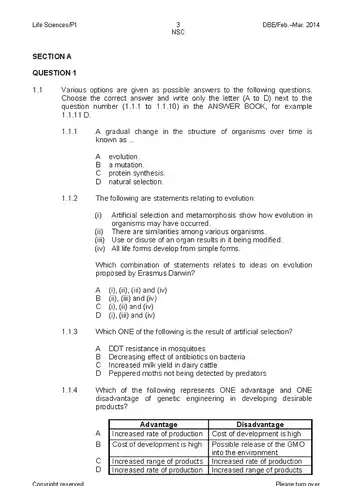
Genetics and inheritance 1.1 Various options are given as possible answers to the following questions .
Q2
Meiosis 2.1 Study the diagram below, which shows a stage in protein synthesis. 30 marks
Q3
3.1 Many species of cichlid fish are found in Lake Mal awin Ai frica. All these 30 marks
Q4
4.1 The table below shows the birth weight and the number of babies that survive
Instructions to candidates Answer ALL the questions. Write ALL the answers in the ANSWER BOOK. Start the answers to EACH question at the top of a NEW page. Number the answers correctly according to the numbering system used in this question paper. Present your answers according to the instructions of each question. Do ALL drawings in pencil and label them in blue or black ink. Draw diagrams or flow charts only when asked to do so. The diagrams in this question paper are NOT necessarily drawn to scale. Do NOT use graph paper. You must use a nonprog- rammable calculator, a protractor and a compass where necessary. Write neatly and legibly.
Feb/March Supplementary 2014 Paper 2 (National DBE)
Life Sciences (Biology) Grade 12 Feb/March Supplementary 2014 Paper 2 (National DBE) question paper
150 marks · 2 h 30 min · 15 pages · 4 questions
What is in this paper (4 questions)
Q1
Human reproduction 1.1 Various options are given as possible answers to the following questions .
Q2
Responding to the environment (humans) 2.1 The diagram below represents a c-rsosecstion of a human seminiferous 30 marks
Q3
3.1 The table below shows the changes in the population size of a type o finsect 30 marks
Q4
4.1 Read the passage below and answer the questions that follow.
Instructions to candidates Answer ALL the questions. Write ALL the answers in the ANSWER BOOK. Start the answers to EACH question at the top of a NEW page. Number the answers correctly according to the numbering system used in this question paper. Present your answers according to the instructions of each question. Do ALL drawings in pencil and label them in blue or black ink. Draw diagrams or flow charts only when asked to do so. The diagrams in this question paper are NOT necessarily drawn to scale. Do NOT use graph paper. You must use a nonprog- rammable calculator, a protractor and a compass where necessary. Write neatly and legibly.
Life Sciences Grade 12 Term 1 2013 question papers and memos
Feb/March Supplementary 2013 Paper 1 (National DBE)
Life Sciences (Biology) Grade 12 Feb/March Supplementary 2013 Paper 1 (National DBE) question paper
150 marks · 2 h 30 min · 16 pages · 4 questions
What is in this paper (4 questions)
Q1
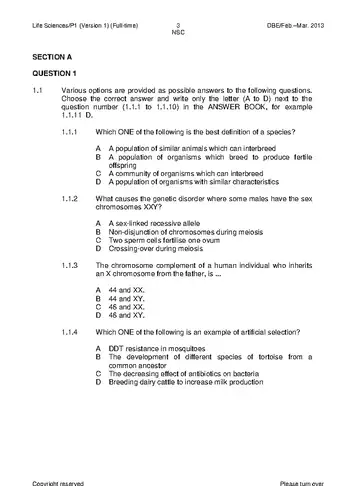
Genetics and inheritance 1.1 Various options are provided as possible answers to the following quesonsti .
Q2
DNA and protein synthesis 2.1 The diagram below shows part of aDNA molecule in a nucleus just before 30 marks
Q3
Evolution 3.1 Professor Lee Berger and his coleagl ues studied the fossils they found in a 30 marks
Q4
4.1 A group of learners investigated the frequency of domntina and recessive
Instructions to candidates Answer ALL the questions. Write ALL the answers in your ANSWER BOOK. Start the answers to each question at the top of a NEW page. Number the answers correctly according to the numbering system used in this question paper. Present your answers according to the instructions of each question. ALL drawings should be done in pencil and labelled in blue or black ink. Draw diagrams or flow charts only when asked to do so. The diagrams in this question paper are NOT necessarily drawn to scale. Do NOT use graph paper. You must use a noprnog- rammable calculator, protractor and a compass, where necessary. Write neatly and legibly.
Feb/March Supplementary 2013 Paper 2 (National DBE)
Life Sciences (Biology) Grade 12 Feb/March Supplementary 2013 Paper 2 (National DBE) question paper
150 marks · 2 h 30 min · 13 pages · 4 questions
What is in this paper (4 questions)
Q1
Evolution 1.1 Various options are given as possible answers to the following ques ti ons.
Q2
2.1 Study the three diagrams (A, B and C) below that show how a population of 30 marks
Q3
Evolution 3.1 The table below shosw different types of waste and their decomposition 30 marks
Q4
4.1 Homo sapiens share some characteristics with other primates, one of which is
Instructions to candidates Answer ALL the questions. Write ALL the answers in the ANSWER BOOK. Start the answers to EACH question at the top of a NEW page. Number the answers correctly according to the numbering system used in this question paper. Present your answers according to the instructions at each question. Do ALL drawings in pencil and label them in blue or black ink. Draw diagrams or flow charts only when asked to do so. The diagrams in this question paper are NOT necessarily drawn to scale. Do NOT use graph paper. You may use a non-programmable calculator, protractor and compass. Write neatly and legibly.
Life Sciences Grade 12 Term 1 2012 question papers and memos
Feb/March Supplementary 2012 Paper 1 (National DBE)
Life Sciences (Biology) Grade 12 Feb/March Supplementary 2012 Paper 1 (National DBE) question paper
150 marks · 2 h 30 min · 15 pages · 4 questions
What is in this paper (4 questions)
Q1
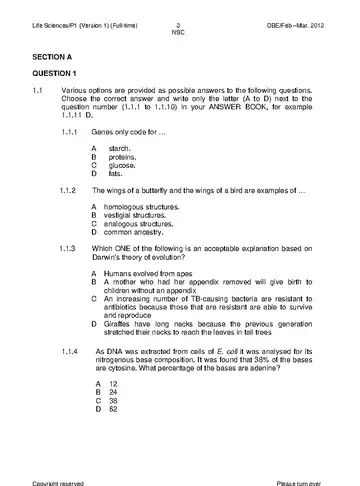
Evolution 1.1 Various options are provided as possible answers to the following question s.
Q2
Meiosis 2.1 Study the diagrams below which illustrate some phases of meiosis I. 30 marks
Q3
Evolution 3.1 A young couple wants to have a child, but they are aware of a serious genetic 30 marks
Q4
4.1 The table below shows the percentage distribution of blood groups in a
Instructions to candidates Answer ALL the questions. Write ALL the answers in your ANSWER BOOK. Start the answers to each question at the top of a NEW page. Number the answers correctly according to the numbering system used in this question paper. Present your answers according to the instructions of each question. ALL drawings should be done in pencil and labelled in blue or black ink. Draw diagrams or flow charts only when asked to do so. The diagrams in this question paper are NOT necessarily drawn to scale. Do NOT use graph paper. You may use a non-programmable calculator, protractor and a compass. Write neatly and legibly.
Feb/March Supplementary 2012 Paper 2 (National DBE)
Life Sciences (Biology) Grade 12 Feb/March Supplementary 2012 Paper 2 (National DBE) question paper
150 marks · 2 h 30 min · 16 pages · 4 questions
What is in this paper (4 questions)
Q1
Evolution 1.1 Various options are given asble answers to the following questions. possi
Q2
Human impact on the environment 2.1 Lichens are small, light-coloured organisms that can be used as pollution 30 marks
Q3
DNA and protein synthesis 3.1 Study the basic plans of three different vertebrate limbs shown below.
Q4
4.1 The table shows the average number of two types of fish, herring and cod,
Instructions to candidates Answer ALL the questions. Write ALL the answers in your ANSWER BOOK. Start the answers to each question at the top of a NEW page. Number the answers correctly according to the numbering system used in this question paper. Present your answers according to the instructions of each question. ALL drawings should be done in pencil and labelled in blue or black ink. Draw diagrams or flow charts only when asked to do so. The diagrams in this question paper are NOT necessarily drawn to scale. Do NOT use graph paper. You may use a non-programmable calculator, protractor and a compass. Write neatly and legibly.
Life Sciences Grade 12 Term 1 2011 question papers and memos
Feb/March Supplementary 2011 Paper 1 (National DBE)
Life Sciences (Biology) Grade 12 Feb/March Supplementary 2011 Paper 1 (National DBE) question paper
150 marks · 2 h 30 min · 14 pages · 4 questions
What is in this paper (4 questions)
Q1
Human reproduction 1.1 Various options are provided as possible answers to the following question s.
Q2
DNA and protein synthesis 2.1 Study the following diagrams representing different phases of meiosis. 30 marks
Q3
Human reproduction 3.1 The diagram below represents the female reproductive system. 30 marks
Q4
4.1 Explain THREE advantages of using genetically modified organisms as food. (6)
Instructions to candidates Answer ALL the questions. Write ALL the answers in your ANSWER BOOK. Start the answers to EACH question at the top of a NEW page. Number the answers correctly according to the numbering system used in this question paper. Present your answers according to the instructions of each question. Do ALL drawings in pencil and label them in blue or black ink. Draw diagrams or flow charts only when asked to do so. The diagrams in this question paper are NOT necessarily drawn to scale. Do NOT use graph paper. You may use a non-programmable calculator, protractor and a compass. Write neatly and legibly.
Feb/March Supplementary 2011 Paper 2 (National DBE)
Life Sciences (Biology) Grade 12 Feb/March Supplementary 2011 Paper 2 (National DBE) question paper
150 marks · 2 h 30 min · 12 pages · 4 questions
What is in this paper (4 questions)
Q1
Evolution 1.1 Various options are given ase answers to the following questions. possibl
Q2
Human impact on the environment 2.1 Lichens are small organisms that can be used as pollution indicators. Lichens 30 marks
Q3
Evolution 3.1 Darwin noticed different species of tortoises on the Galapagos Islands. Two of 30 marks
Q4
4.1 The table below shows the annual catches of TWO species of fish, namely
Instructions to candidates Answer ALL the questions. Write ALL the answers in the ANSWER BOOK. Start the answers to EACH question at the top of a NEW page. Number the answers correctly according to the numbering system used in this question paper. Present your answers according to the instructions at each question. Do ALL drawings in pencil and label them in blue or black ink. Draw diagrams or flow charts only when asked to do so. The diagrams in this question paper are NOT all drawn to scale. Do NOT use graph paper. You may use a non-programmable calculator, a protractor and a compass. Write neatly and legibly.
No papers match. Clear the filters
Questions about these papers
Which years of Life Sciences (Biology) Grade 12 Term 1 papers are on this page? Papers from 2026, 2025, 2024, 2023, 2022, 2021, 2020, 2018, 2017, 2016, 2015, 2014, 2013, 2012, 2011. The newest year is at the top.
How many marks is the Life Sciences (Biology) Grade 12 Term 1 paper? The paper is usually out of 60 marks and you get 1 hour to write it.
How many marks is the Life Sciences (Biology) Grade 12 Term 1 paper 1? Paper 1 is usually out of 150 marks and you get 2 h 30 min to write it.
How many marks is the Life Sciences (Biology) Grade 12 Term 1 paper 2? Paper 2 is usually out of 150 marks and you get 2 h 30 min to write it.
Are the memos included? Yes. 21 of the 25 papers on this page have their marking memo next to the question paper.
Is there Life Sciences (Biology) Grade 12 Term 1 study material on this page? Yes. 7 files for Term 1: notes, lesson plan and question paper.