Engineering Science N3 April Past Papers and Memos
2013 to 20218 papers29 PDFsAfrikaans
Advertisement
This page has every Engineering Science N3 April paper we have, from 2013 to 2021: 8 question papers and 4 memos in 29 PDFs. Files are in Afrikaans. The newest year is first. Each paper shows the first page of questions, its marks and time, and what the questions cover.
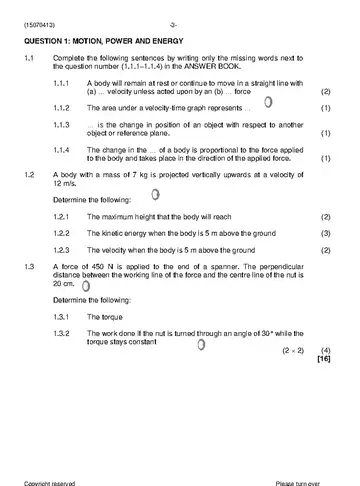
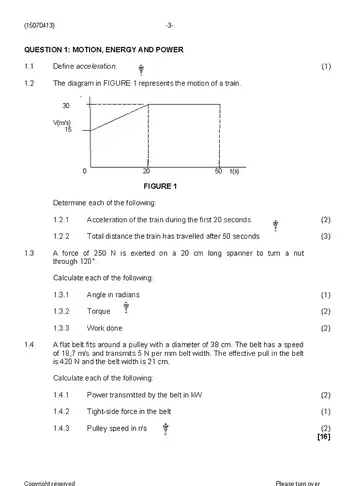
Q1Motion, Energy and Power1.1 Define acceleration. (1)16 marks
Q2Moments2.1 Define torque. (2)12 marks
Q3Forces3.1 Define parallelogram of forces. (2)14 marks
Q4Friction4.1 State THREE principles of kinetic friction. (3)12 marks
Q5Heat5.1 Name THREE factors on which the increase in length depends if a metal rod15 marks
Q6Hydraulics6.1 Write an equation of delivery head in terms of suction head and static head. (2)12 marks
Q7Electricity7.1 Explain potential difference of a cell. (1)13 marks
Q8Chemistry8.1 Give the number of valence electrons for alkali earth metals. (1)6 marks
Instructions to candidates
Answer all the questions.
Read all the questions carefully.
Number the answers according to the numbering system used in this question paper.
Keep subsections of questions together.
Rule off on completion of each question.
Answers must be rounded off to THREE decimals.
All calculations should consist of at least the following THREE steps: • Formula used or manipulation thereof • Substitution of given data in formula • Answer with correct SI unit
Drawing instruments must be used for all drawings. All drawings and diagrams must be fully labelled.
Use the constant values on the attached information sheet where applicable.
2 Use g = 9,8 m/s .
Write neatly and legibly. (15070413) -3-
Engineering Science N3 April 2019 question papers and memos
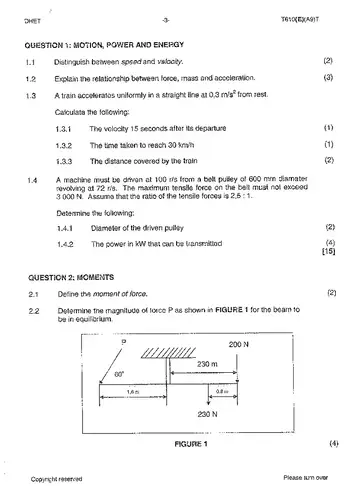
Q1Beweging, Energie en Krag1.1 Onderskei tussen elastiese botsing en onelastiese botsing. (2)16 marks
Q2Momente2.1 Omskryf die moment van ’n krag. (2)12 marks
Q3Kragte3.1 Onderskei tussen die ewewigskrag en die resulterende krag. (2)14 marks
Q4Wrywing4.1 Noem DRIE voordele van wrywing soos dit op ingenieurswese betrekking het. (3)12 marks
Q5Warmte5.1 Verduidelik wat met die soortlike warmtekapasiteit van ’n substansie bedoel15 marks
Q6Hidroulika6.1 Noem TWEE tipes druklesings wat op ’n vloeistof geneem kan word. (2)12 marks
Q7Elektrisiteit7.1 Wat word met die EMK van ’n sel bedoel? (1)13 marks
Q8Chemie8.1 Wat is ʼn ioon? (1)6 marks
Instructions to candidates
Answer ALL the questions.
Read ALL the questions carefully.
Number the answers according to the numbering system used in this question paper.
Answers must be rounded off to THREE decimal places.
All the calculations should consist of at least the following THREE steps: 5.1 The formula used or the manipulation thereof 5.2 Substitution of the given data in the formula 5.3 The answer with the correct SI unit
All drawings/diagrams must be fully labelled and drawing instruments must be used.
The constant values, as they appear on the attached information sheet, must be used wherever possible.
Keep subsections of questions together.
Rule off on completion of each question. 2
Use g = 9,8 m/s
Write neatly and legibly. (15070413) -3- T640(E)(A1)T
Advertisement
Engineering Science N3 April 2018 question papers and memos
Q1Beweging, Energie en Krag1.1 Noem die verskil tussen 'n vektorgrootheid en 'n skalaargrootheid. (2)16 marks
Q2Momente2.1 Wat word met skuifkrag bedoel? (1)11 marks
Q3Kragte3.1 Verduidelik wat bedoel word met die gevolg van 'n aantal kragte. (2)10 marks
Q4Wrywing4.1 Wat word bedoel met wrywingshoek? (1)14 marks
Q5Hitte5.1 Gee TWEE voordele van stoom. (2)15 marks
Q6Hidroulika6.1 Skryf 'n vergelyking vir 'n suighoogte ten opsigte van 'n uitlaatdrukhoogte en12 marks
Q7Elektrisiteit7.1 Skryf Faraday se eerste wet van elektrolise in woorde neer. (2)16 marks
Q8Chemie8.1 Gee die definisie van 'n ioon. (1)6 marks
Instructions to candidates
Answer ALL the questions.
Read ALL the questions carefully.
Number the answers according to the numbering system used in this question paper.
Answers must be rounded off to THREE decimal places.
ALL the calculations should consist of at least the following THREE steps: The formula used or the manipulation thereof Substitution of the given data in the formula The answer with the correct SI-unit
Drawing instruments must be used for all drawings/diagrams. All drawings/ diagrams must be fully labelled.
One mark indicates one percentage point, that is 100 marks = 100%
The constant values, as they appear on the attached information sheet, must be used wherever possible.
Keep subsections of questions together.
Rule off on completion of each question.
2 Use g = 9,8 m/s
Write neatly and legibly. (15070413) -3- T640(E)(M29)T
Engineering Science N3 April 2016 question papers and memos
Q1Movement1.1 A car travelling at 20 m.s applies its brakes and stops after 50 m.16 marks
Q2Moments2.1 State the definition of a force. (2)13 marks
Q3Forces3.1 State the definition of equilibrant of forces. (2)15 marks
Q4Friction4.1 Distinguish between static friction and kinetic friction.11 marks
Q5Heat5.1 Explain the law of conservation of energy. (2)15 marks
Q6Hydraulics6.1 Explain the following terminology in hydraulics:12 marks
Q7Electricity7.1 Explain the concept power factor, and distinguish between a high power12 marks
Q8Chemistry8.1 Name TWO precautions to keep moisture and water away from metals which6 marks
Instructions to candidates
Answer ALL the questions.
All calculations should consist of at least THREE steps: 2.1 The formula used or manipulation thereof 2.2 Substitution of the given data in the formula 2.3 The answer with the correct SI unit
The constant values, as they appear on the attachment information sheet, must be used wherever possible.
Number the answers according to the numbering system used in this question paper.
Keep subsections of questions together.
Rule off on completion of each question.
Drawing instruments must be used for all drawings/diagrams. All drawings/diagrams must be fully labelled.
Use g = 9,8 m/s2.
Answers must be rounded off to THREE decimal places.
Write neatly and legibly. (15070413) -3- T580(E)(M30)T
Engineering Science N3 April 2015 question papers and memos